
mfgLuxe: Fender 5E3 Tribute Build
Building a tube amp had been on my bucket list for many years.
I wanted to know amps worked, how the circuit designs and components affected the sonic results. I wanted to know how to competently diagnose and service my own amps without getting electrocuted, of course.
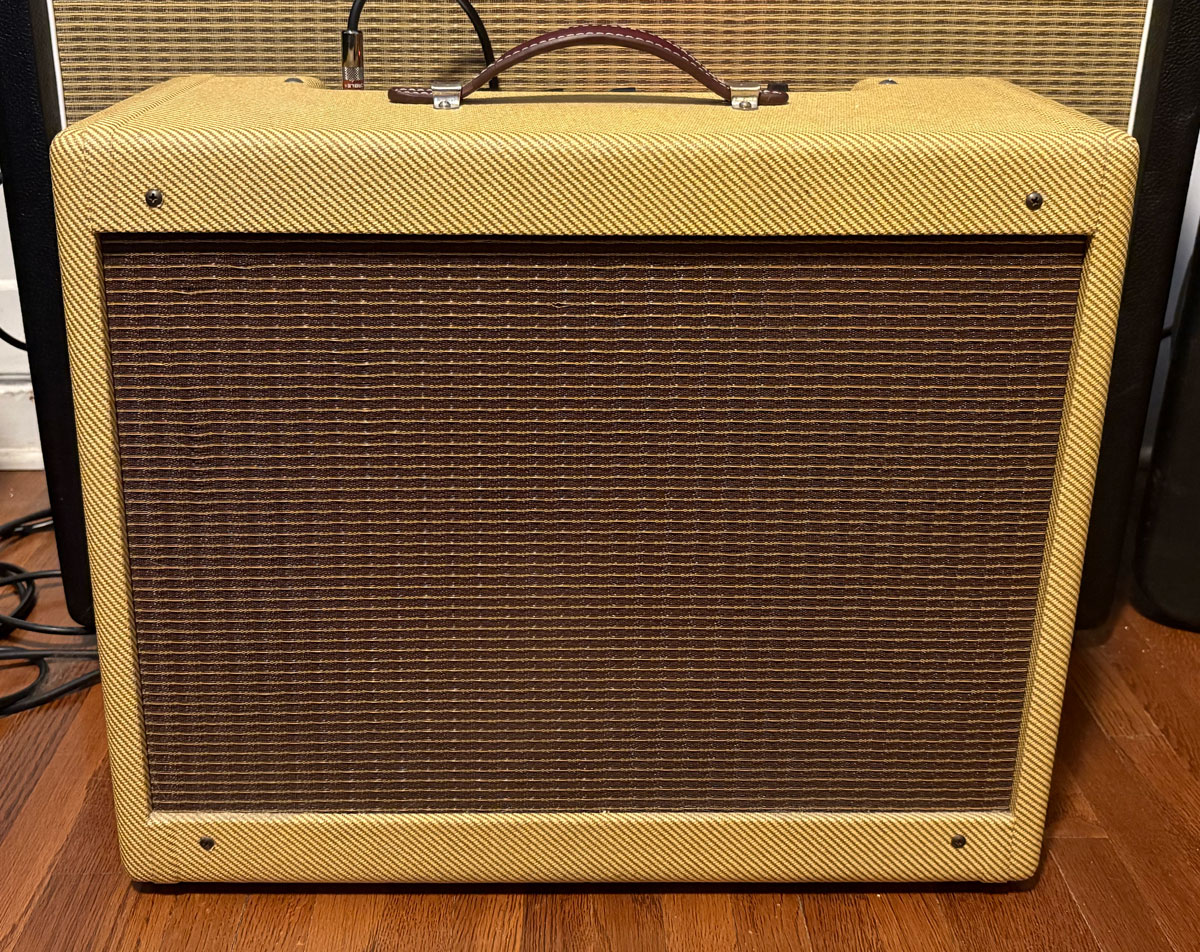
 When I started seeing the first DIY tube amp kits started coming to market I got really excited at the prospect of building one as a jumping off point into the tube amp world. It seemed like a logical first baby step in the right direct towards my tube amp knowledge goals and I already had highly developed soldering skills but even so, it would take many years before I would actually take the plunge. The reasons were sound; I already had a too many amps and too little space, or I didn’t have the time, or I didn’t want to spend the money, and so on…
When I worked with Roger Curtis (founder of Associated Electrics) I learned not only that he was an avid audiophile but prior to opening AE he was an electrical engineer at McDonald Douglas. Although Roger wasn’t a musician he was the perfect guy to talk to about tube amps and what made them tick. I’d show him schematics of different Marshall clone kits I was considering and at a glance he knew what was going on with the circuits. Not surprising being that tube amps were quite simple compared to the aerospace projects Roger worked on at his previous job. Even with as Roger as a sage and seemingly willing resource, as he was always down to talk about amplification while I worked at Associated, it wouldn’t be until the COVID19 lockdown of 2020 when I would step off into the deep(ish) end.
My friend Dan Janish and I had reconnected after many years and we had lots of ground to cover. We’ve been friends since the mid ’80s meeting via mutual friends in the LA music scene. Dan’s a singer/song writer and since we last spoke he got into building his own guitars and amps. Dan was very encouraging for me to start building my own amps and highly recommended that I begin with a 5E3 kit due to the circuits simplicity and that every guitar player should own a tweed deluxe.
I didn’t know much anything about the Fender Tweed Deluxe 5E3 amp, never having played through one but I trusted Dan’s direction as he has deep Fender amp knowledge. My Fender amp experience was limited as I primarily played Marshalls, Vox AC30s and/or other brand amps based on those. The one Fender amp I had pined for and came very close to buying was the Vibro-King designed by Bruce Zinky, which I absolutely love and still want.
The amp I regretted selling and really wanted own again was the Marshall JTM45. There was a kit available but it was a substantially higher investment compared to the 5E3 kits I was looking at and I thought it would be a reasonable test of concept to see if I could build the Deluxe clone before diving into building the JTM45. If I ran into a wall, at least it would cost me half as much money as the Marshall kit and Dan said Tweed Deluxes are great amps to have around, so that’s the way I went.
After doing my research I pulled the trigger on the 5E3 kit offered by Tube Depot. I went with the Tube Depot kit at the time as it offered the best price point ($610 shipped). The only negative strike on the Tube depot kit was that it came with a PCB (printed circuit board) rather than a traditional eyelet board.
Being that I really wanted to build the amp using an eyelet board, I found one available at Mojotone that cost less than $20. So, I purchased the eyelet board and upgraded the tube sockets as per Dan’s recommendation and still for considerably less cost than the other comparable kits. Perhaps a little ambitious of me for my first amp build but I figured I could retro fit the eyelet board with only the slightest of pain.
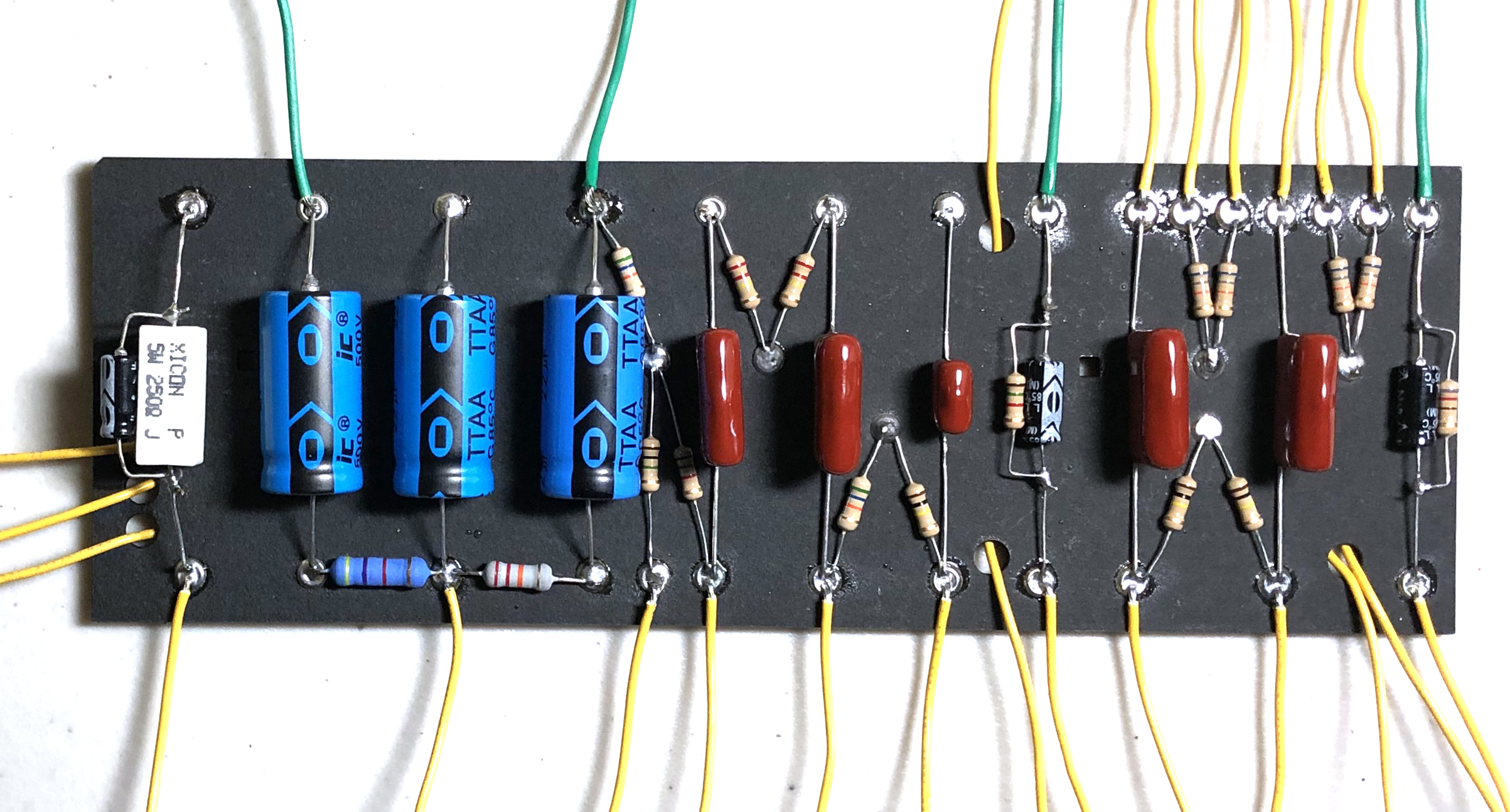
The 5E3 kit went together pretty quickly, even as I triple checked my work in my most sincere effort to not burn down our home. Referencing 5E3 kit manuals from both Tube Depot and Mojotone I was able to retrofit the eyelet board with the ease of drilling holes in the chassis for the circuitboard standoffs. Piece of cake!
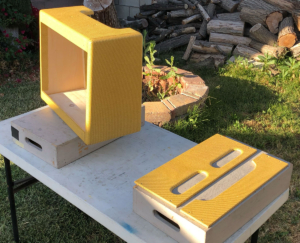 It all went together quite smoothly with the most time consuming part of the project being finishing the cabinet with lacquer, which I was able to get done in an afternoon. I used a brush on Deft product, it may have been a shellac. It came out very nice although I would liked the finish to be a bit thicker but it was good enough and I was ready to get it buttoned up.
I got the 5E3 assembled and was ready to start testing. I was nervous but I followed the directions fastidiously and triple checked all the connections. I began the test procedure and everything was measuring to specification. The time came to put the tubes in and fire it up. OMG – IT’S ALIVE! I’m playing and sound is coming out the speaker, the pots are working and that’s about when I started to smell the smoke – SHUT IT DOWN!
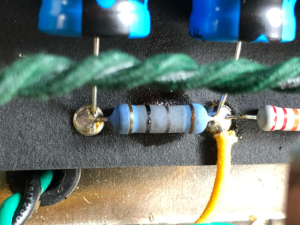 Okay, what happened..? I pulled the chassis out of the cabinet and checked everything again one more time. The only thing I found was a resister that looked a bit toasty. After a lengthy consult with Dan I replaced the cooked resistor with a new one. There was no clear reason as to what caused the resister to burn, so let us try this one more time. And just like that, the amp has worked like a champ (or should I say Deluxe, heheh) ever since!
It was a very rewarding experience building this 5E3 kit from a bag of parts to a functioning usable amplifier. This amp has basically taken over living room duty from my old Peavy Classic 30. The C30 is fine but I’ve grown to really appreciate and enjoy the 5E3 although it took awhile for me to get there with it, as I didn’t like when I first started playing it.
As I started playing through the little amp, demoing several different guitars and adjusting the controls I couldn’t find that magical Tweed Deluxe charm that I heard so much about. The sound was brittle and harsh, lacking warmth, certainly nothing like what I imagined I’d hear. Honestly I was a bit disappointed with it but I figured it was either user error or just not my thing, or perhaps a bit of both, but I wasn’t close to giving up on it just yet.
After messing with the amp for a while and still unable to find the magic in my 5E3 build, my friend Brett offered me an opportunity to play through his original ’58 Fender Tweed Deluxe. I jumped at the chance eager to see what I was missing out on and to expose my ears to a gold standard reference. And that it was, Brett’s ’58 Deluxe brought the tone. Holy cow that amp sounded good, gooey, creamy, harmonically rich and yummy. When I think of all the times I passed these amps by without any consideration, I had no idea these sounded so good!
Armed with a really good ’58 Deluxe reference in my ears, I left knowing much more about what my 5E3 was lacking, but I wasn’t sure how or if I could get mine there. Weeks went by and the dust began to collect on my little amp. It would come up in conversation occasionally but I got tired of trying to force a good sound from it. I just lost interest in struggling with the 5E3 when every other amp I had sounded so great and gratifying.
Dan had suggested swapping the speaker out as a possible remedy. Changing out speakers in amps and cabinets had never really been a thing I did as an exercise to chase tone. In my mind if the cabinet sounded good, it’s good and speakers get fixed when they blew. I do have some different cabs loaded with different speakers that have different sonic qualities, but I never got into the granular aspect of auditioning speakers for amps and/or cabinets, although I’m very aware that it’s a thing that some people go deep into.
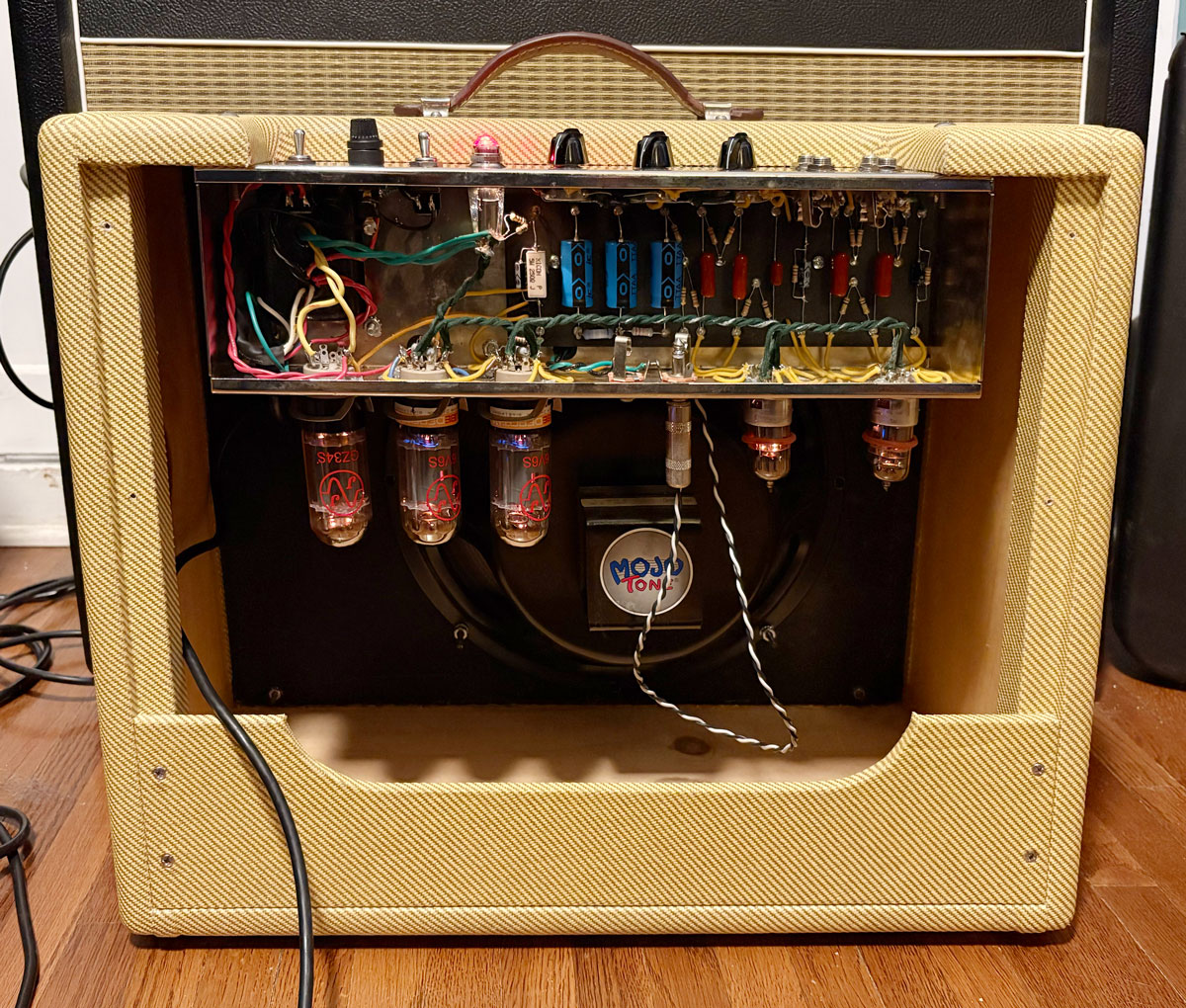 It may have been over a year and after I built my mfg45 Marshall JTM45 clone, when a friend of mine told me about a speaker he had that might be a good fit for my Deluxe. He had a bunch of speakers hanging on his wall, one of which was a used Mojotone 12″ Alnico speaker made by Eminence, I believe the model is a MP12RHD but I’m not sure as there was no packaging or label to indicate. The speaker measured in the 8 ohm range and I figured for $50 it was worth a shot.
As luck would have it, the speaker swap from the stock ceramic speaker to the Mojotone Alnico speaker was a huge improvement! The amp sounded so much smoother and harmonically richer, it was a whole new and much improved beast! The only concession was that the Alnico speaker gave up a little bit of headroom which I happily accepted as a good trade, now that the 5E3 has gone from doorstop to delightfully usable!
In my pile of amps that I use are two Vox ACX30s that have the Celestion Alnico Blue speakers that sound fantastic. Using those AC30s I was aware of that sonic specialness that low watt alnico speakers delivered but it wasn’t until I swapped the speakers out in my Deluxe clone when I heard the profound difference it could make.
My amp with the stock kit ceramic speaker my amp went from unused dust collector to my daily player, that’s a big improvement! Although my 5E3 clone still isn’t quite as magical as Brett’s original Fender ’58 Tweed Deluxe, it got a lot closer with the alnico speaker and now it’s getting played, which was all that I could’ve hoped for. The moral of the story: when finding ones self stuck against the, try going a different direction as it may take you where you want to go! I’m glad that I did!
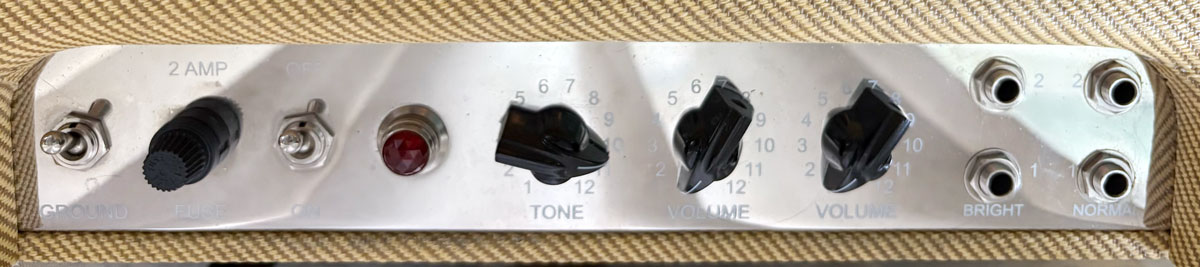 Fun fact: The 5E3 has a bright and normal channel, each with a volume control and a master tone knob. There are high & low inputs for each channel, four in total. Simple enough but what’s interesting is that all of the controls will influence the sound regardless of the channel being used. For example, if you’re running through the normal channel the volume knob for the used bright channel still has influence on the sound and can shift the tone and volume. Just a strange feature of the simple circuit that can help dial in a sound.